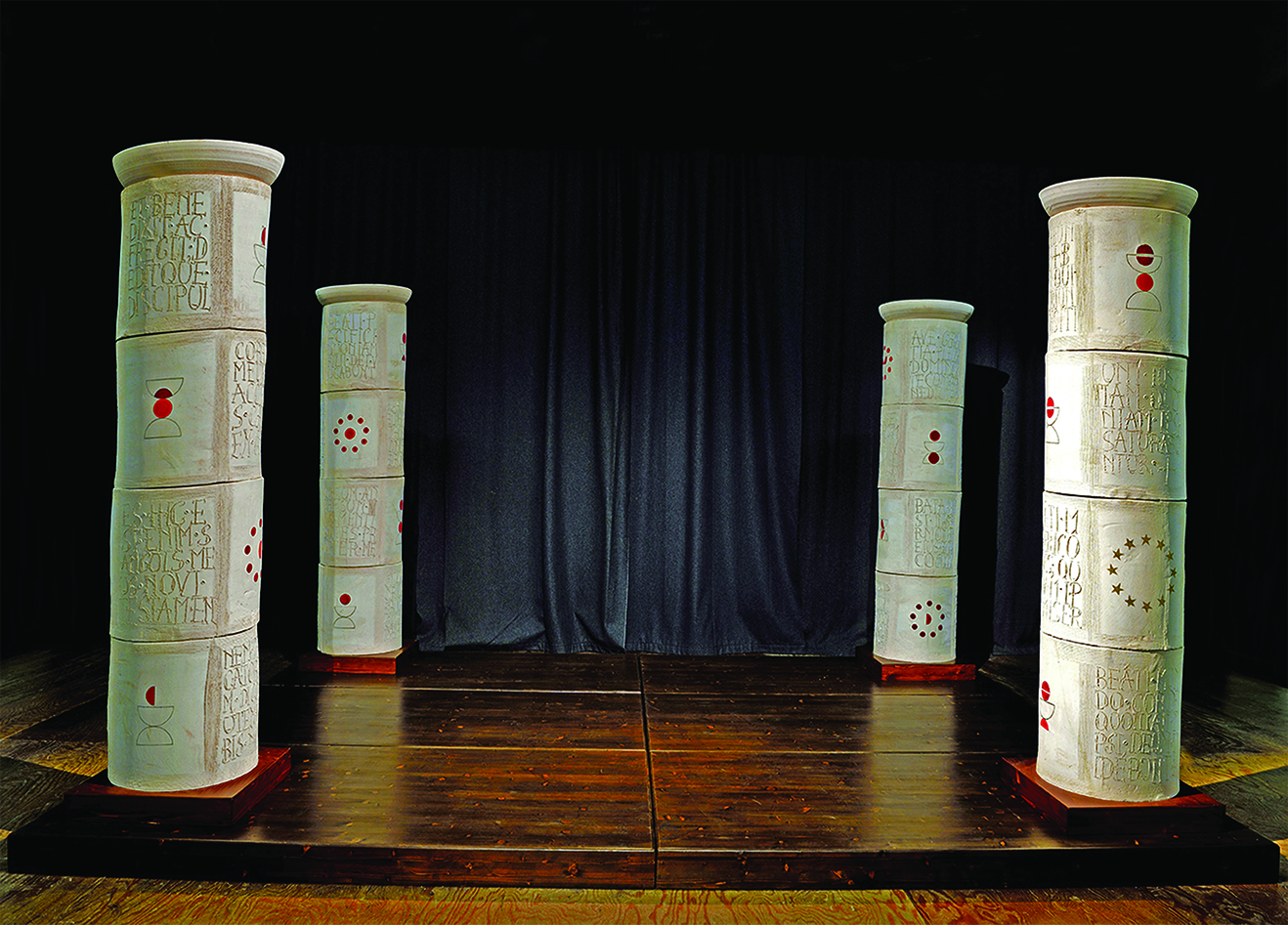
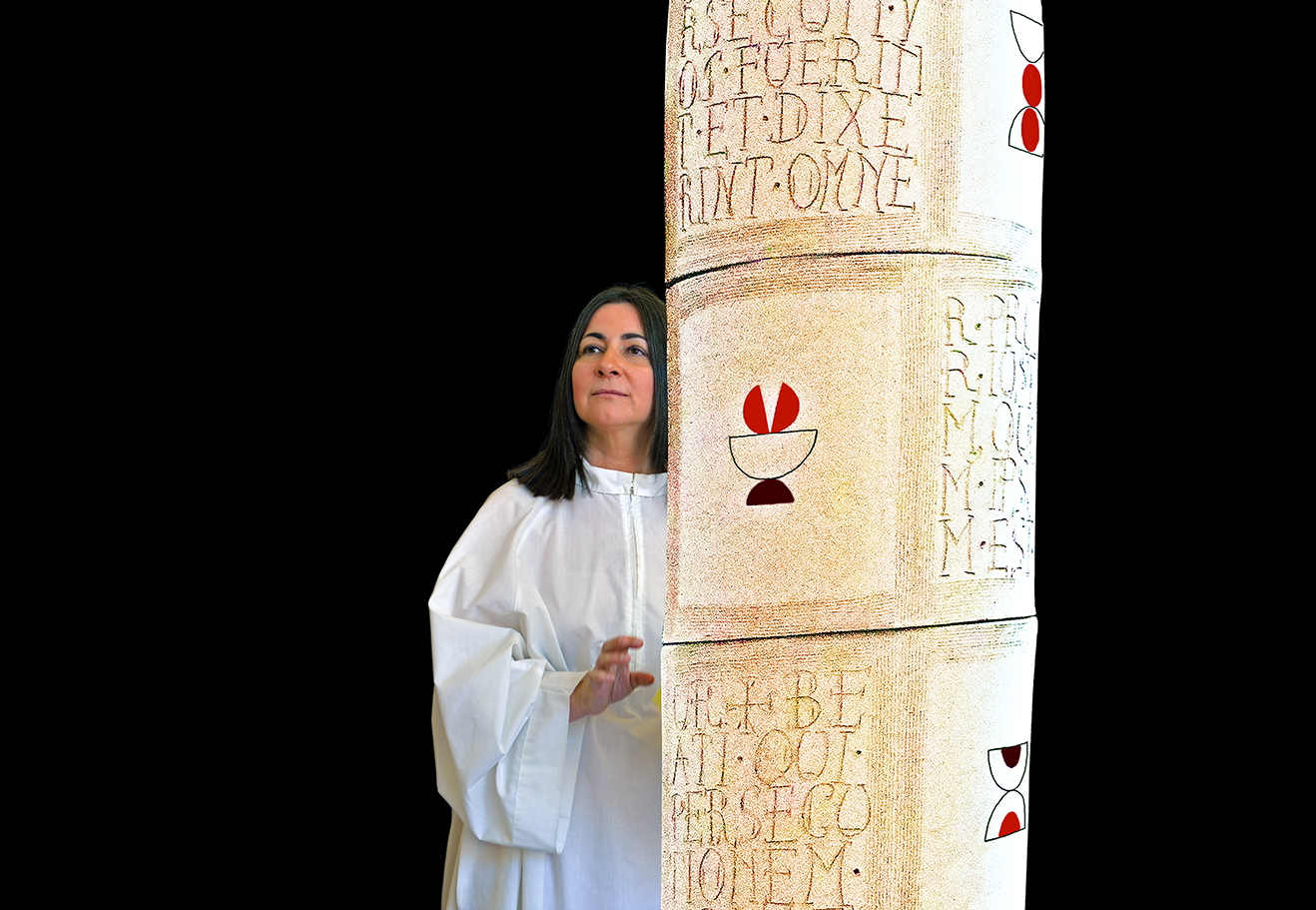
A shared space where differences meet
and each identity retains its uniqueness.
Space becomes a place of connection, expression and encounter.
Four columns define an intimate setting, open to
the many possibilities of human experience. Marks, symbols and words
coexist in a visual language that embraces
differences and, through them, seeks a shared dimension.
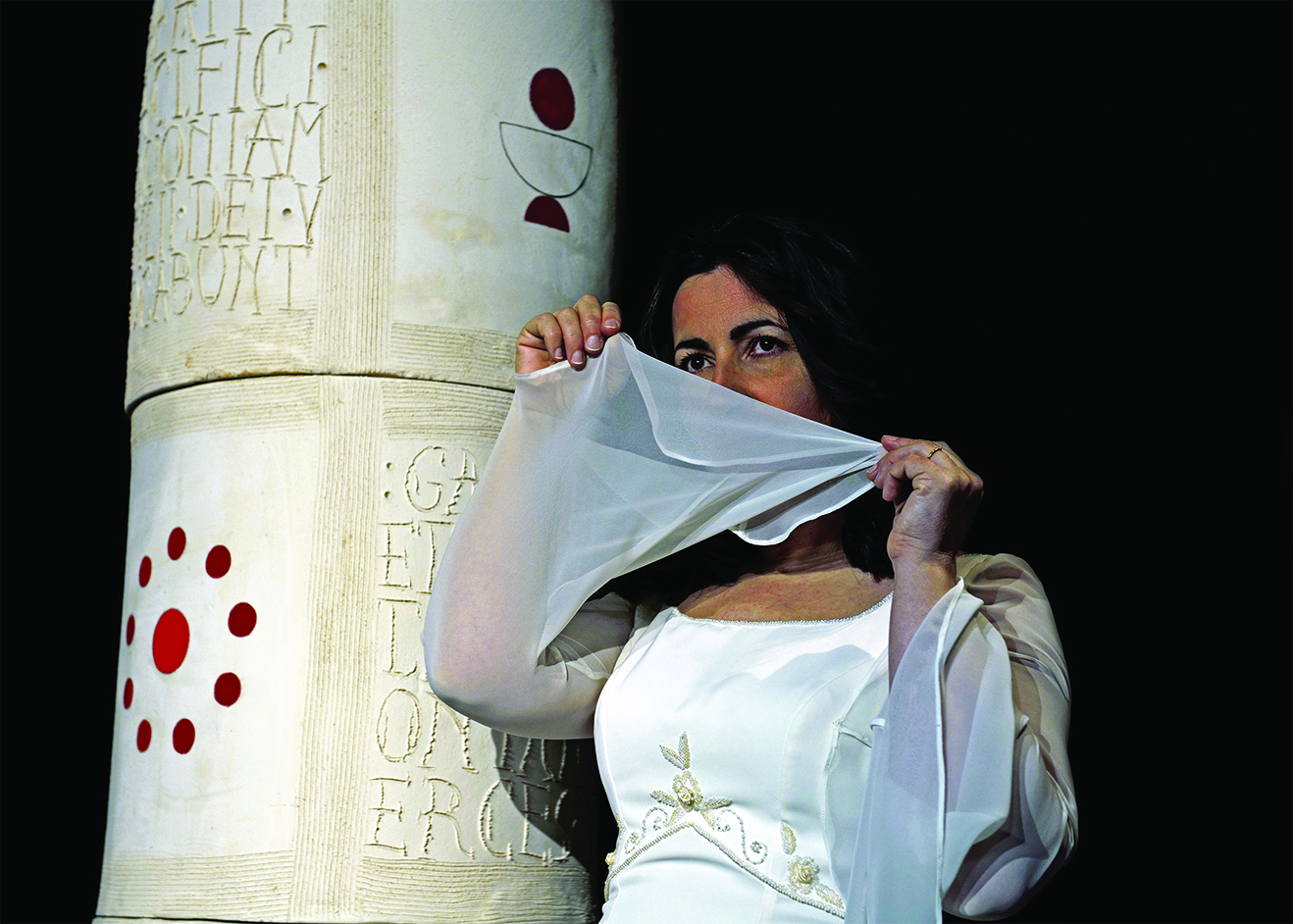
Cristina Bonucci in the performance
Il nostro Dio e il vostro
sono lo stesso Dio
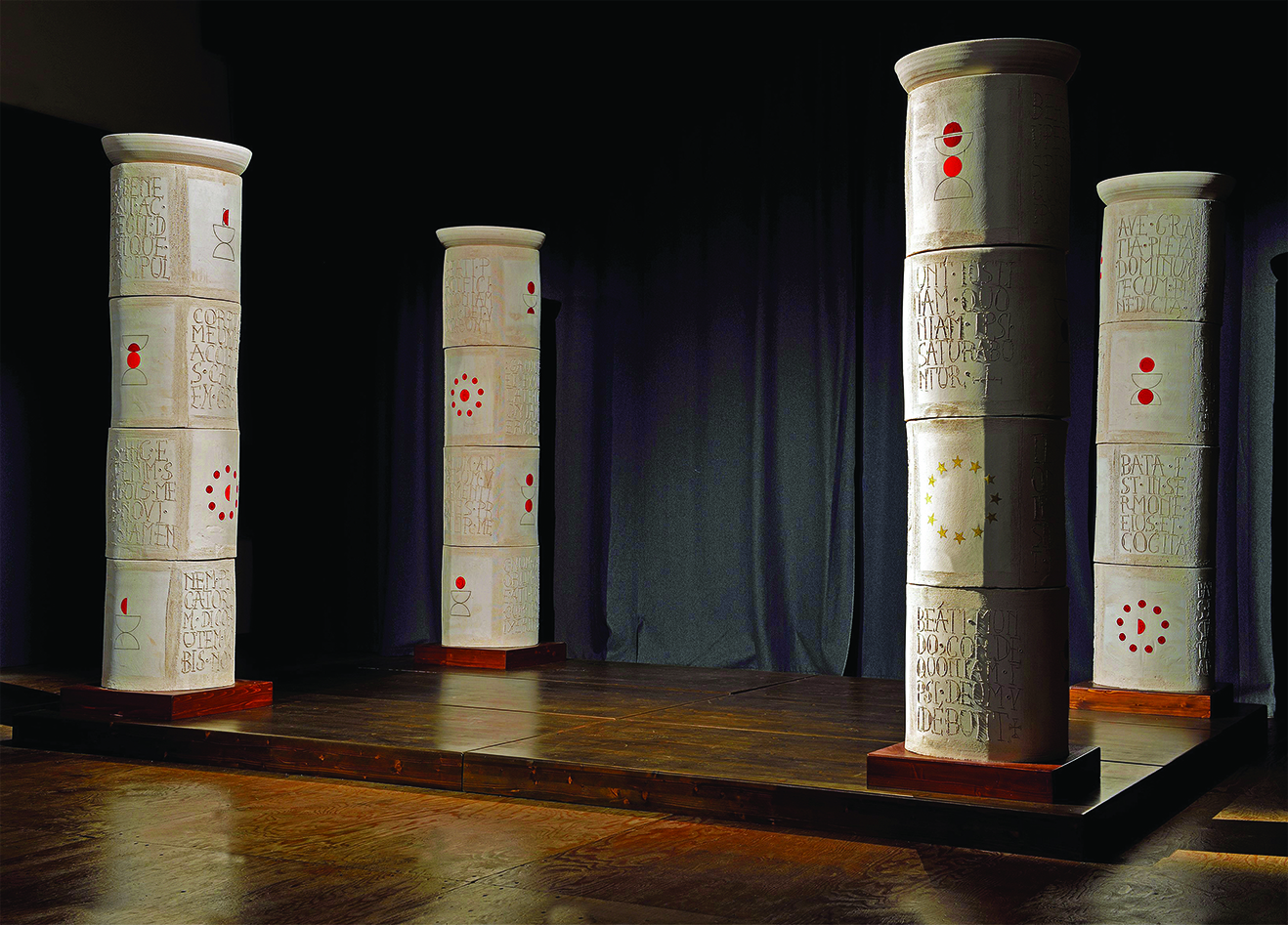
Lo studiolo dell'artista:
luogo d'incontro - 2014
semire, graphite and acrylics on
a wooden base - cm. 300 x 400 x 225 (h)
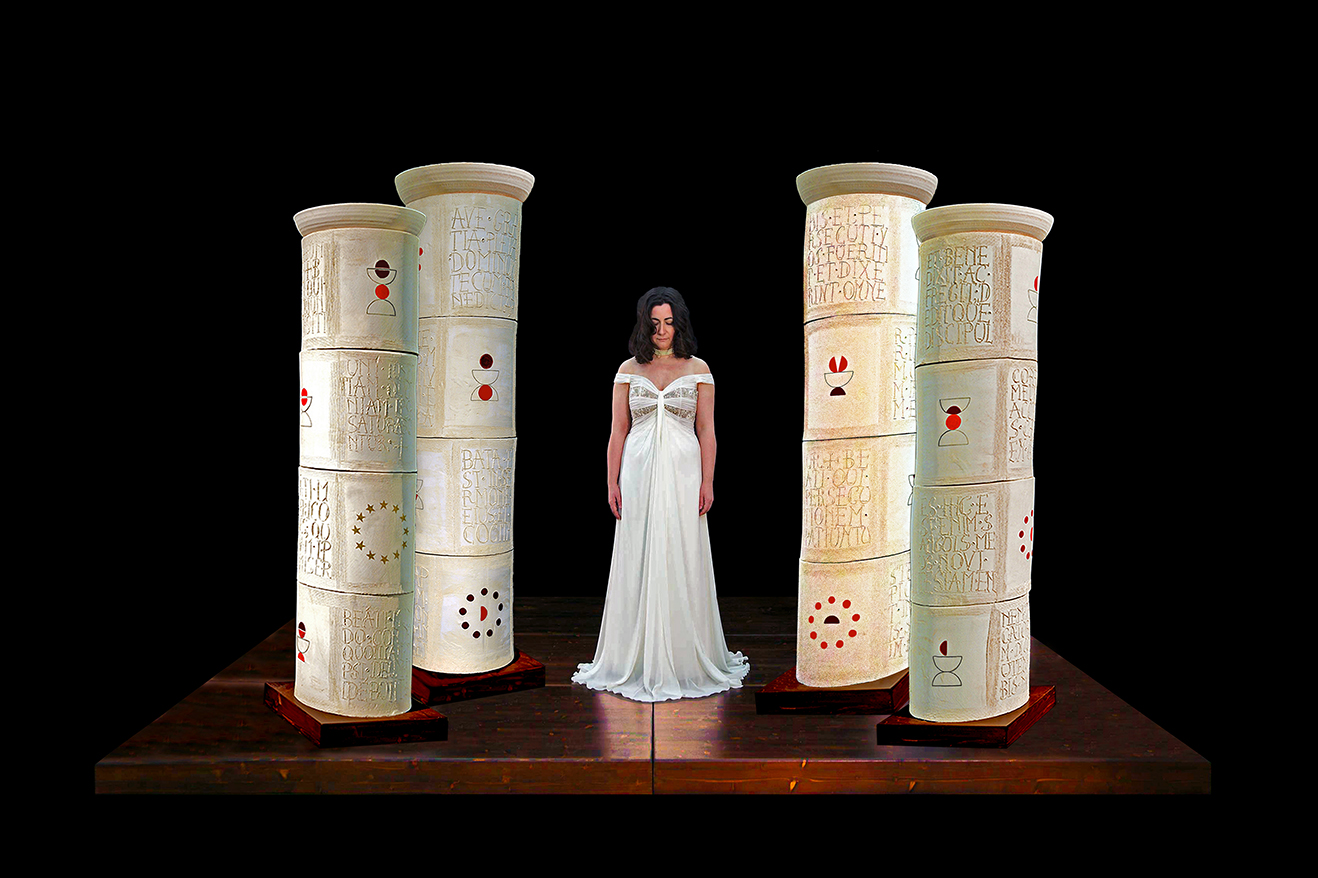
Lo studiolo dell'artista:
luogo d'incontro - 2014
semire, graphite and acrylics on
a wooden base - cm. 300 x 400 x 225 (h)
The four columns, distinct yet belonging to a single structure, define a shared space. Within the work, diverse languages and identities find a place to coexist, where difference is not erased but recognised as part of a possible unity.
A selection of critical texts devoted to the themes of the unity
and the difference in Cristina Bonucci's artistic practice.
All rights reserved.
There is a moment, an incalculable and often unexpected trice in some people's life, in which a change happens in a so sudden and so strong way, to influence the following course of a whole life. Perhaps, similar to that which Montale called, in the poetry Fine dell'infanzia1 (End of childhood), as the "violent minute"; the instant in which we realize a decisive inner change by the way we relate both to the outside and to ourselves. It is, therefore, a shift, sometimes cathartic, which implies the passage from a status in which every single moment of the experience is assimilated by the life flow and by the passage of time without leaving traces in the memory and in the sense of judgment, to another one characterized by the action of the categories aimed to problematize and to reelaborate our dialogue with the surrounding, bringing with it, moreover, important existential implications. It is legitimate - in writer's opinion - to believe that Cristina Bonucci's artistic story starts right here, from a feeling as unexpected as intense, stronger than any other thing and, therefore, able to subvert her intimate relationship with all happened after that; always in the sign of art and spirituality. The passage from the bachelor's degree with final thesis, also published, focused on the figure of Bronislaw Malinowski, founder of the social anthropology, to the artistic activity, took place in an uneasy if not even suffered way, due to a personal crisis that involved her in the 1994; year in which she moved to Marina Mahler's house of Spoleto, nephew of the famous composer Gustav and daughter of the sculptor Anna. Here she, thanks to Marina's help too who gave her hospitality to help her during this very difficult period, after days of lonely reflections but also of important and enlightening meetings with characters and representatives of international culture, an unspecified morning of November, suddenly, began to work the clay with unprecedented confidence. From this episode, she never stopped to cultivate the sculptural practice extending then, progressively and in a second time, her interest in drawing, painting, performance, design and graphics. Her first official participation in an exhibition dates back to 1996, in a group show of ceramists in the hometown of Spoleto, entitled Dio, non dei (God, not gods). In this circumstance, the young artist decided to deal with the story of Salvation, perhaps because, in that segment of her human journey, she felt this theme of extraordinary closeness. Part of the artworks here exhibited, such as Illuminazione (Lighting) and Oltre c'è solo la vita e il silenzio (Beyond there is only life and silence), developed from the archetypal form of the Star of David resolved in the shades of gold and white, marked, however, by an additional small triangle in the center representing, symbolically, the Trinity and which, progressively, prevailed in the overall formal structure of the works. Others, instead, sank their reasons in ancient Egyptian mythology and religion, presenting phallic forms attributable to the figure of the god Min2 that held up a shelf structuring, in this way, a table or altar. After this first exhibition, the artist began to work with greater clarity of her communicative intentions and aesthetic purposes. What, suddenly, had arisen as an unexpected but necessary and spontaneous action of resilience in reaction to a moment of difficulty, the art making, is now being revealed, to the author's conscience, like a practice that, having come as a real vocation, she would never have been able to abandon. Since 1998 she has been working focusing on the study of anatomy, generating a cycle of achievements that can be denoted both by visual and emotional feedback; Impronte (Imprints). They born after a long period of intellectual gestation and depth analysis regarding the work of Yves Klein, author by her highly esteemed and to whom she dedicated the performace Omaggio a Yves Klein (Homage to Yves Klein), happened in the same year on the occasion of the group show Se son rose fioriranno, (If they are roses they will bloom) curated by Julian Zugazagoitia. In fact, from their analysis, we can well glimpse an ideal stylistic genealogy, delineating them as plausible filiation, with the Anthropometries of the artist of Nice who with Umbria region, having been a devotee of Saint Rita from Cascia, had a such particular bond to go there once to leave an Ex-voto still preserved in the Basilica dedicated to the "Saint of the impossible". The Imprints, however, differently from the aforesaid Klein's series that has a performative nature and with which, nevertheless, they share a graphic representation sometimes similar, are originated from a decidedly more mediated process - this is here a determining factor - reaching complementary outcomes. From Cristina Bonucci's interpretation, emerges a much less impetuous and physical reading than that one of the French artist. She outlines a more delicate, tenuous and tending to abstraction paraphrase, in which color becomes evanescent and osmotic, in an attempt to grasp the impermanence of the human presence considered not as a bodily entity but, contrarily, like an indefinite trace portrayed in the act of transcending, of sublimating itself. To dominate, in this square of solicitations, is a sense of enigmatic rarefaction. The following year, this family of artworks caught Zugazagoitia's attention, in that period director of the Festival dei Due Mondi of Spoleto (for three consecutive years) and, at the same time, curator of the visual arts department of the Guggenheim Museum in New York and, later, director of the Barrio Museum and, nowdays, of the Nelson Atkins Museum of Art in Kansas City. He was so positively smitten by the Impronte cycle that he followed the artist for a period of her activity and invited her to the United States. Invitation that she declined for personal reasons. Also Giorgio Bonomi, contemporary art critic and director of the specialized magazine Titolo, manifested interest in regards to her Impronte editing the special Labili tracce d'esistenza (Fleeting existence traces) and curating a solo show with the same title and focused on this series in Torgiano. As well as Sanjay Tikku, philosopher trained in Cambridge, Phd at Harvard and, currently, teacher at the University of Hong Kong, became passionate about this cycle and curated, in 2000, her solo show Opere (Artworks) also writing the critic text, Il corpo Di-Spiegato (The Body De-Ployed). In the meanwhile, the artist continues to experiment the sculpture arriving, in the same year, to conceive and to create her first large sculpture designed for an open environment; the viewpoint of the Spoleto Fortress. This is Componente del 2 (Element of 2), a work based on the contrast between the solid geometry of the underlying part, albeit mitigated by the transparency of the lexan, and the levity, but not without tension, of the upper one and that tells about the end of a love story. The experimentation in the sculptural field does not end here but continues with Raccolta davanti a te (sitting in front of you), a monumental sculpture designed for the Mandarini green area of Torgiano and inaugurated in 2006 after a preparatory study made of sketches, projects and models that lasted about three years. The artwork tells about the gradual detachment of the artist from the male figure that, positioned at a dizzying height and obtained by full shapes, communicates an anxious sense of imminence deriving from the contrast with the threadlike parts that support them. As well as the previous one, also this artwork is distinguishable for the predominance of slender and upward morphologies. Looking for a common semiotic aspect shared by these two sculptures, it is recognizable in the author's insistence on the close comparison between contrasting forces, synthesized by unstable reciprocity played on the imbalances generated by gravity, physicality, lightness and material. In parallel, also the activity of drawing and painting proceeds, reaching evocative outcomes. The management and the opening, from 2008 to 2012, of the art and iconography studio Spoleto Galleria, allows us to understand how much the sensitivity towards the ancient and the themes belonging to the sphere of the sacred – already lucidly detectable since her beginnings – had a substantial centrality for her. This predisposition can be identified in the reproduction, using the traditional Byzantine technique, of icons and artworks with religious subject from the aura, at times, oriental, paleochristian in others and, in others still, of the fifteenth century. This group includes paintings created using ancient materials and inspired by La Santissima Trinità and La Vergine della Tenerezza by the great Russian iconographer Andrej Rublëv, as well as the local La Natività by Filippo Lippi and La Santissima Icona, both visible inside the Cathedral of Spoleto. It is part of the same creative inclination, allowing us to understand how, in her experience, the role of the artist goes, in certain situations, hand in hand with her way of living the sense of mystic, even the drawing on wood of the crucifix of Christus Triumphans, inspired by the original by Alberto Sotio, preserved in the city Cathedral. Some of these artworks, originated both from the intention to experiment a stylistic research on the visual culture of the past and from a devotional push, together with other elaborations of those years, were the object of the exhibition Ikonen, Zeichnungen und Skulpturen (Icons, Drawings and Sculptures), held in 2009 in the German city of Schwetzingen inside the Catholic church of Saint Pancrazio. An artistic practice with such ethereal contents as the one just described, is accompained, as if to confirm the already intuited author's polymorphous creativity, by pencil self-portraits on paper, made during the early years of the 2000s, characterized by a nervous, restless and fast gestures, extremely communicative and direct in the language that exude, resorting to very few but incisive elements, the anguished author's state of mind in the period of their execution. Drawings like these, perhaps, represented the unavoidable passage to arrive, through the key of art, to something bigger that could drive away, forever, the ghosts of the past. In the same location, the artist explores the territories of design and applied arts, creating refined furnishing objects - real little sculptures - lamps in semi-refractory earth, table set, chairs and tables in finely worked iron. In 2013, with Lo studiolo dell'artista: luogo d'incontro (the artist's studio: meeting place), Cristina Bonucci confronts herself with sculpture in interior space, delineating a most collected, ordered and measured relationship with it. The work, hosted in numerous museums, consists of four columns in white refractory earth, graphite and acrylics resting on wooden bases. Being habitable and having variable dimensions, it is perfectly comparable to an installation. Moreover, precisely because of this factor and as if the artwork was born to be lived, it also worked the stage for her three performances Preparate la via del Signore (Prepare the way of the Lord), Mi chiamo Cristina Matilde Maria Rita...e tu? (My name is Cristina Matilde Maria Rita ...and you?) and Il nostro Dio e il vostro sono lo stesso Dio (Our God and yours are the same God), then merged into the art video Trilogia (Trilogy). Presented in preview in 2015 at the Festival dei Due Mondi to then be repeated, in the following year, in the Church-Museum of San Francesco in Montone during the Umbria Film Festival and, in 2017, at the Marini Clarelli Santi Foundation in Perugia on the occasion of a solo show curated by Cecilia Metelli, the video intends to find reasons of thinking for a possible dialogue between Jews, Christians and Muslims, recalling the sacred texts of the three most widespread religions in the world. For the topic and the way it has been investigated, the video was the pretext to organize a series of meetings in order to analyze this issue with greater precision. To highlight the urgency and the burning relevance of the chosen thematic, it is useful remember that, just four months after the first presentation, the tragic terrorist attacks at the Bataclan in Paris happened. The three sculptures of the A Kengo Kuma (To Kengo Kuma) group, made in 2016 and dedicated to the famous Japanese architect, are aimed to celebrate the friendship between Italy and Japan. They also, from December of the same year, before being acquired by the museum of Palazzo Collicola to enrich its permanent collection, were exhibited there with a project curated by Gianluca Marziani; at the time director of the institution. In the first work, the religions of the two nations - Catholicism, Shintoism and Buddhism - are compared, specularly, inside a small typical Japanese architecture and are identified by the respective symbols. In the second one, as if to switch from the sacred to the laic, we find, inserted inside a pagoda, the three main state offices of the two countries. The third, focused on the primeval energies of nature, hosts images of aurora, sunset and night as if to give an ancestral and timeless dimension to all the artwork. Finally, the three pieces, almost to underline an even more atavistic genealogical commonality, are ideally united by the use of basic geometric shapes like the square, the circle and the triangle. As immediately deducible, it is easy to realize, from the reading of the artist's experience, the way in which her path has followed a plurality of both technical and disciplinary addresses. This attitude has profiled, in the overall view of the aesthetic outcomes, a rather articulated possibility of reading with both horizontal breadth, therefore relative to the diversity of the adopted executive means, and vertical depth, therefore concerning the specific study dedicated for each expressive solution and the thematic variation. All, is often explored by artist with a dialectical approach, therefore showing the purpose to define a synthesis between thesis and antithesis. However, identifying a constant effectively capable of combining so heterogeneous aspects it, subliminally, can be recognized in the discreet search for a point of congruence where unity and difference fade over one another until their assimilation. This can be found, in fact, both in the outdoor sculptures, where the large dimensions allow to understand the aforementioned balance of conflicting impulses, and in the decision of considering the monotheisms, although respecting the specificities of each, as various aspects of a same truth, and in celebrating the communion between different and distant cultures like the Italian and the Japanese ones. Reached the impassable wall of the present and the ridge of these 25 years of activity, that has seen the succession of phases of great success with others not certainly simple, it seems reasonable to say – according to the writer – that the choice to make a check on her work corresponds to the idea to hypothesize a balance and sign a perimeter but, even more, to the need to overcome it. All, in order to continue to look towards the horizon of the future with faith and, above all, with the ability of renovation that, as can be seen both from the examples of her work and from her biography, has constantly distinguished Cristina Bonucci's human and artistic figure. All, weighed within an existential boundary where art and life, after having run after each other in various situations, have reached a point of overlapping, perhaps inextricably.
1 Cfr: EUGENIO MONTALE, Fine dell'infanzia, in, Ossi di Seppia, Gobetti Editions, Turin, 1925.All rights reserved.
Cristina Bonucci has been working for quite some time with the shape of the human body - whether it be of a model or her own - and has gradually freed herself of the initial Klein influence to the point of it being markedly abstract, so much so that the anatomical shapes are hard to identify. Here we would like to describe a work by Bonucci which, though it dates back a few years (1999), has never been exhibited or published. It is almost as if the artist preferred to let it "age," a sign of a work that is not afraid of the passing of time (though not much time has passed). The work is serial and is composed of fifteen diptychs - each one however with a life of its own - with a first part in common titled "La morte è lo scheletro" ("Death is the skeleton") with two circles, or holes, next to each other horizontally, and a second part, each one with a different name. What we have in front of us is a complex work, starting from its material composition, which in itself would need a detailed analysis in order to fully understand its meaning: it is a metaphor for life, both in general and on the individual and daily level of the life of the artist herself. In other words it is a self-examination that is able to grasp the meaning of existence for each and every one of us. Death shown as a skeleton is a recurring icon in the history of art but here it is displayed as a verbal statement and not as a repetitive imitation: indeed two symbolic "holes" are represented - death as an endless black hole - which however could also be two zeros, which side by side are the mathematical symbol of infinity, that is, death as the infinite void; they might also however be two eyes, sunken and empty, like those of a skull that "looks" on at life as it moves towards death. So, death, that accompanies man since he is born, as described in a famous poem by Leopardi, accompanies the succession - not pre-established - of the other fifteen diptych elements. These contain marks that cannot always be easily recognized, but we understand that they are traces of the body (usually a shoulder, a leg, the pubis, an arm...): technically we see sparse marks that adhere to the ideal "less is more" of most art of the early 20th century, without however the type of design utopias typical of the originator of the phrase. In terms of content, the marks themselves, in order to achieve a deeper comprehension of the work, must be understood in the context of the titles, which can at times be narrative ("non potete dire niente di me") ("you can say nothing of me"), evocative ("maternità") ("maternity"), descriptive ("sembrano i capelli di un volto invisibile") ("they resemble the hair of an invisible face"), of a trite daily condition ("che palle, fan culo!") ("what a pain, screw this!"), of an existential condition ("la spirale della vita") ("the spiral of life"), conceptually hermetic ("sequenza I") ("I sequence"), and one can continue with "denuncia" ("denunciation"), "l'affermazione di sè" ("self-assertion"), and still more, as well as provide different meanings. The fact remains that these fifteen diptychs are a sort of synchronic autobiography of the artist, though at the same time it shows the human condition, both in its precarious ontological existentiality as well as in several of its moments, which can only represent one of life's (short) sequences. Indeed existence, either before, during or after, is never described with a complete and well-defined image, but is always on the move and constantly changing, and only these marks - from a pencil, a colour, a n. 14 (which the artist prefers to not describe in more precise terms) or of a different medium - are able to represent it. We however know how the reality of the image that is represented does not exist immediately thereafter. It is "different", just as according to the Obscure from Ephesus one cannot step twice into the same river, since the water in the river does not remain still. Nor does the result change if we use a more advanced technique, such as photography or video production. And so if human destiny is precariousness and there is no definitive and complete image of existence, but only uncertain and indefinite marks, the only way for "salvation" is to accept one's condition, with either hope or serene awareness, without giving in to ineffectual illusion or desperate anguish: this is what the diptychs of Cristina Bonucci tell us.
All rights reserved.
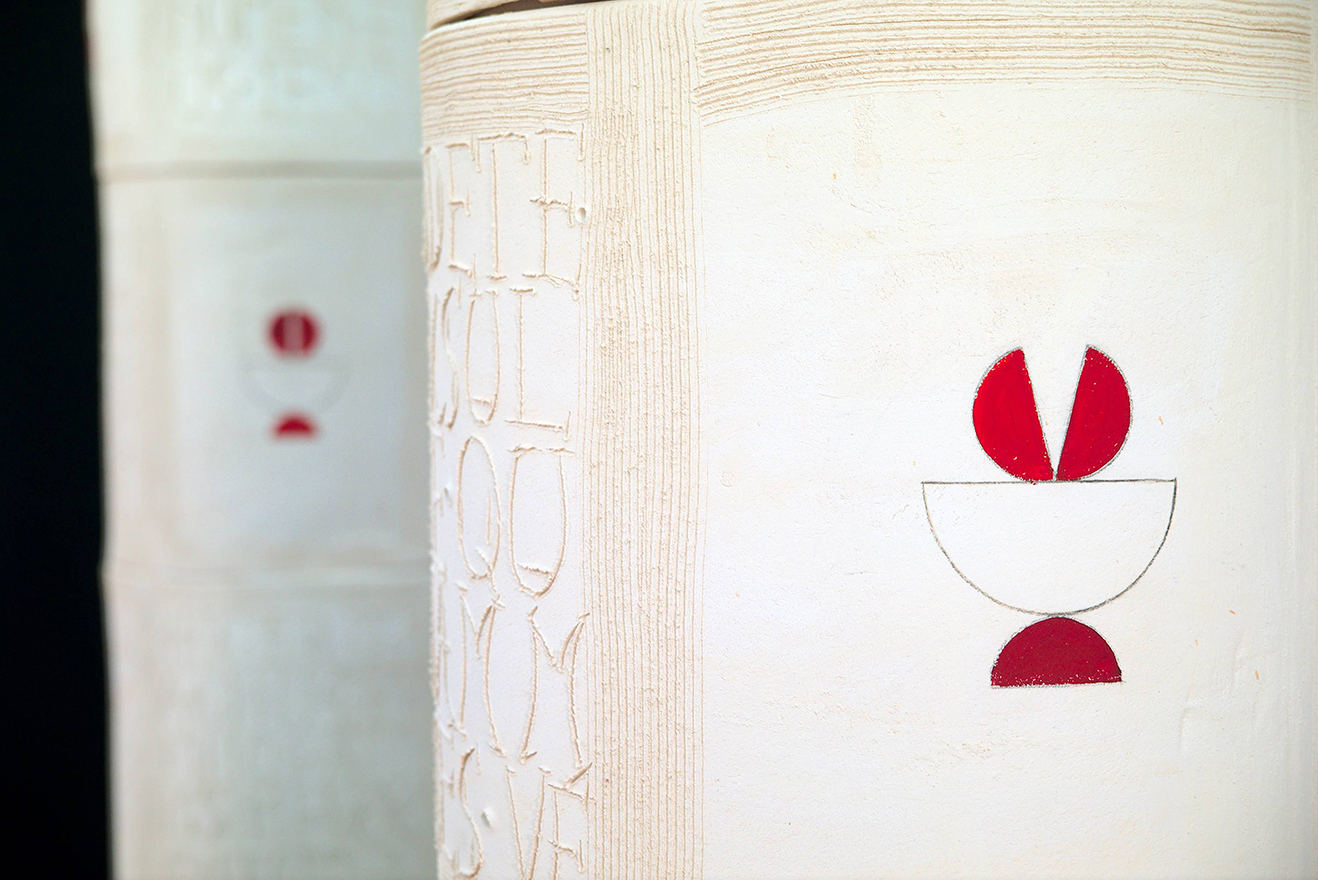
Lo studiolo dell'artista is Cristina MMR Bonucci's first large indoor sculpture project. Her previous sculptures, such as Componente del 2 and Raccolta davanti a Te, are in fact placed outdoors. The studiolo is made from semire clay and consists of four circular columns. Four hollow cylinders with a one and a half centimetres thick wall, created manually and with the help of a lathe, form each column. The capital of the column has the shape of an upside down truncated cone. Each column has a square wooden base. The external surface of the cylinders is divided into squares that have Latin text from the Vulgata, alternated with red acrylic paint and graphite drawings. These four columns lay on a large rectangular-shaped foundation made of wood, which defines a small, compact area that can be used in many different ways. The artist has envisioned the space as a setting wherein people can relax, write, draw, eat, paint, engage in a conversation, sculpt, sleep, perform, exercise, create videos, meditate, take pictures, dance, rehearse, pray, create installations, create music, or play an instrument. It can also be used as a canopy, as a cot for a child, or in any other way you can imagine or desire. In short, it is the focus toward which we converge in order to connect with the most significant part of ourselves and to bring out a pure creative energy that is the starting point for relating with others, whether it dwells within or without us. This space is made sacred by the verses inscribed and the alphabet of symbols drawn and painted by the artist on the columns, which represent traces of the passage or the permanence of the divine in this concluded space, rich with symbols and references. It is a small temple that embraces all languages, idioms and manifold identities, then translates them into a single universal language.
All rights reserved.
Square, rectangle, circle, triangle ... geometry as a dynamic symbology, to reflect on shared ethical values, models of sociocultural equilibrium, and on systems to connect people and communities. Cristina MMR Bonucci has built three domus on a small scale that are a kind of spiritual and meditative scale model, half visionary sculpture and half sensorial scenery. These three architectural islands speak of the sacred and of synaesthesia, of integration and of dialogue, of beauty and of morality. Three mental spaces that tell of a personal voyage with universal appeal, built around symbolic geometries that define nature and its biological cycles.
The show at Palazzo Collicola Arti Visive pays homage to the architectural vision of Kengo Kuma and the holistic spirit of his buildings, amid the scale of the body and the aura of the planet. The works are set up in the Hall on the Main Floor, a room that surrounds us with its theatrical squareness and dizzying height. The volumetric wooden ceiling becomes the ideal counterpoint of the three domus, a geometric sky that participates in the scenic precision of the sculptures, the essential rhythm of their elements, the suspended gravity of the geometry.
The three sculptures integrate outside elements in the severity of the buildings. In the first domus, the artist introduces symbolic archetypes connected to the spiritual realm and to the never-ending search for metaphysical spaces. In the second domus are powerful contemporary people chosen by the artist according to interpretative affinities. For the third domus, the artist chose the evocation of emotions, sentiments, internal inspirations, which link the archetypes of the first domus to the real characters of the second domus.
The triangulation of content integrates the differences and creates a common global conscience of life, relations and beauty.
A KENGO KUMA 1
The work is an homage to the temples of Kyoto and makes use of the habitation theme to present the idea of a dialogue between different cultures and religious archetypes. The sculpture is slightly raised from the ground and embodies the harmonious correlation between Buddhism, Shintoism and Catholicism. The lifted structure represents how spirituality can elevate, while the bamboo canes stand for the synesthetic union between Man and Nature. On each of the three sliding doors is an image which represents the aforementioned religions: Shintoism is represented by the Torii, the gate that is considered sacred by the state religion of Japan; Buddhism by the Bodhi Tree under which it is said Siddhartha Gautama received enlightenment; Catholicism by the Virgin of Tenderness, the quintessential Mother and in perfect harmony with the open values of aspirational architecture. Finally, three texts serve to explain the respective religions, as well as to recreate a visual and philosophical comparison between the original scriptures.
A KENGO KUMA 2
The second domus is inspired by traditional Japanese pagodas. Inside them are people that define the artist's moral narration: Emperor Akihito is placed at the centre of a chrysanthemum, a floral symbol of the Empire; the Crown Prince Naruhito is connected to the sacred cherry flower; the President of the Italian Republic Sergio Mattarella is shown with the Italian Tricolour flag; Pietro Grasso (President of the Italian Senate) with the olive branch; lastly, two women, Virginia Raggi and Yuriko Koike, respectively the mayors of Rome and Tokyo, are shown with Trajan's Column and the Tower with folds of Kengo Kuma.
A KENGO KUMA 3
While the first sculpture enhances the role of the square and the second that of the rectangle, in this sculpture it is the circle and triangle that are highlighted. The images, printed on canvas and fixed on plexiglass, have an ethereal quality: an aurora, a sunset and a night. A sort of escape from a bi-dimensional reality towards a meeting point in which we can become "one", despite our vastly different histories, cultures and civilizations. The centre of the domus contains a small mattress from which one can relax and observe the different phases of each day. The room is raised from the ground and has three small staircases located around the circular perimeter of the pavement.
All rights reserved.
Method, discipline, rigor: three qualities that exalt the clear essence in this howling present that distracts from silence; three attitudes to be cultivated in the life path that participates in the form of the work. The artist incorporated in her own essence embodies the search for purified inner geographies: a demanding attitude in a system increasingly polluted by photographic overkill, by narcissistic overflows, by the dissonance of urban noise. Resistance (defense from the outside) is needed to maintain this rigor, the result of method and discipline, but also the dialogue with some parts of the external world, those from which the artist absorbs sap in a filtering selection of data, so as to evolve without dissipating oneself, resembling a castle within an ideal society that redefines itself beyond urban formalism, beyond politics, beyond the façade of events.
An evolutionary era of the human species grows around us, something that is going beyond science fiction to define the threshold of the Novacene, towards that inductive leap in which Man and Machine will process their epochal synergy, in the shared hope that technology is an integral part of an ethical and sentimental revolution. Things are now changing at breakneck speed, analog rituals shift the rules towards fluid processes, metaphysics revises the access codes of its own philosophical engine. These leaps are frightening, no sense in denying it, and lead us to a decisive fork in the road: either one can adapt mimetically to the new, in a conscious manner, watching over the roots but shifting reception onto the filaments of tomorrow; or one can be anchored in one's own certainties, holding onto the fear of progress and the calm of an isolated but safe landing place. In between there are hybrid positions that only artists can occupy: because only they can deal with the contradiction coherently and aesthetically, only they aspire to the metaphysics of social events, wiping the present in a highly symbolic, metaphorical synthesis.
Cristina Bonucci holds on to her town, Spoleto, while she aspires to the construction of her spiritual city: that Interior Castle where she can protect herself in order to practice the discipline of the work, in a constant play of mirrors between the life of the soul and social reality. It is not superfluous to have grown up in a place acclaimed by writers and poets; a green land of medieval fortifications that weaned many saints; the compression of the stone that becomes the nucleus inside a theater of natural protection, among mountains and broad panoramas, at the foot of an Albornozian fortress that fuels the visionary emotions of those who build interior edifices. Spoleto has the urban profile of the ideal city a unique case of a large city in miniature, where the evidence of Power and Culture is found among palaces, theaters, churches and other buildings with national dimensions and global ambitions. Our artist has metabolized these backdrops, defining the archetype of her personal architecture, made of marks and signs, along the Cartesian direction of Teresa of Avila, her elective guide towards the achieving of full interior writing.
Stone becomes a stronghold of inner boundaries, a spiritual decumanus that welcomes the manifold nature of the intimate journey, the significant stages of a long meditation that has no prologue or epilogue, but only gradual knowledge, an unveiling, the glimmerings of dawn. Bonucci traces sinuous lines within these borders, she makes unusual leaps and movements, explores up high and down low, without the boundary ever becoming a prison, without the walls transforming into pure impact.
Her stride is rigorous, methodical, disciplined; her action is decisive, sharp, mineral.
Striding and acting merge in her method and are expressed in the synthesis of her visionary gaze. The resulting work is an arcadian mineral that absorbs light so as to generate its prismatic reflection. A clear light that is inner energy, carved and chiseled by years of discipline, by a method that refines the perimeters of the rooms, designs doors and windows, inserting only what is necessary, sublimating the futile in the tension of essence beyond absence.
Architecture is a fundamental theme for the artist, an epic of the spirit in which I see visual passages from Italo Calvino's "Invisible Cities", but also the tormented utopias of Franz Kafka. Architecture of the essence that is rooted in philosophies leading to the reality of Kengo Kuma, the Japanese architect that the artist has "read" and settled, creating sculptural maquettes with the shape of the utopian temple. Three resonant objects that we exhibited while I was director of Palazzo Collicola Arti Visive, the museum in Spoleto in which I created a hortus conclusus of research on the local area, reasoning with the method of local observation within a global contemplation, with the same thrust of the architecture that includes the genius loci within a radiant aesthetic.
Today the artist aspires to the real construction of a habitable architecture, where the body exists and subsists, tracing lines of trends that only discipline makes visible to the naked eye. It is an imposing sculpture, similar to a multicellular organism, born from the proton of the castle of Teresa of Avila, filtered through interpretations through which Bonucci does not manipulate the roots, but models the archetypes, maintaining the praxis of the origins within a figurative rhythm that will occupy a welcoming landscape (the place where the work will one day be installed).
The Castle the mystic speaks of would be the life of everyone, a place belonging exclusively to us, inside which is the room where God, Master of the Castle and our lover, awaits us. That room represents our room and yet, according to Teresa's words, we almost always find ourselves outside the castle, wandering and begging for alms, not understanding how and when to cross the threshold in order to enter something that already belongs to us.
Teresa of Avila: "Today I was begging the Lord to speak in my place, because I did not know what to say, nor how to begin to obey the command that was given to me, and this is what came to mind... ...We can consider our soul like a castle made of a single diamond or a very transparent crystal, in which there are many mansions [rooms one after another, ever more internal], as there are many in heaven... and so how must be the room in which a King so mighty, so wise, so pure, so full of riches, takes his pleasure? No, there is nothing that can be compared to the great beauty of a soul and its immense capacity!...".
The task of the art critic must deal with something much broader than the works in the catalog. In this case the dialogue activates the deep part of analytical morality, that space in which the spiritual becomes vertigo spiraling downward and upward, with a centripetal gravity that leaves you suspended between nearness and horizon, between your intellectual baggage and the other in its practicable distance. The words of Teresa of Avila cause detonations of the soul, cathartic thrusts that go beyond personal religious beliefs. In my case, as an agnostic in a continuous inner exercise, I refer to "The Kingdom" by Emmanuel Carrère, an investigation into Jesus and Saint Paul which is a lay stratagem for confronting one's own spiritual dilemmas. At a certain point, speaking about those for whom the superficial cycle of living is not enough, Carrère writes: "... it is that they have never recovered from a sort of astonishment that prevents them from living without asking why they live, what is the meaning of all this, if there is one. For these people, existence is a question mark, and even if they don't rule out that there is no answer to this question, they are looking for it, they can't help it. Since others have searched for it in the past, and some even claim to have found it, they are interested in their testimonies. They read Plato and the mystics, becoming so-called "religious beings," without being involved with any Church... ".
I feel this way every time I activate the spiral of doubt; I feel this way while I read the Spaniard's words, so powerful and yet distant from my real life, from my lack of faith, from my doubting in order to grow. The mystic's sentences penetrate into my inner discipline, adding questions with uncertain answers, drawing sketches of that ideal castle which one enters not with a certificate of faith, but by an act of trust. I cannot say if I will ever reach the seventh mansion, driven along the path by the wind of experience, nor am I able to imagine myself in a life of methodical prayers; even so, I understand very well the discipline behind the metaphor if the dwelling, driven by a critical path that leads me to feelings through sharing with the artist.
Teresa of Avila: "So let us go back to our castle and its many mansions. You don't have to picture these mansions one after the other as a series of rooms. Bring your gaze to the center, where the King's apartment or palace is located. He lives there as in a palm kernel, the good part of which you cannot get except by removing the many leaves that cover it. So it is here: around and above the central room, there are many others, every part of which is illuminated by the Sun that resides in the middle. The things of the soul must always be considered with breadth, extension and magnificence, without being afraid to exaggerate, because the capacity of the soul goes beyond all human imagination. It matters a lot that a soul of prayer, at whatever level it has reached, is left free to move about as it wishes, up, down, and sideways, without driving it into a corner and limiting it to a single room."
I practice the discipline of doubt every day, stimulated by the reflections that artists place before the world in which we live. The deductive leap always happens with works full of entrances and exits, pieces that invite you to enter without telling you which lock to open; on the contrary, they succeed in confusing you so that you get involved, without the trick of charming surfaces. Let us not forget it: a piece of art works when it produces a perceptive and preceptive maze, a spatial and temporal labyrinth where many get lost and only some open the right doors, giving form to their own interior castle.
Cristina Bonucci waits for the right moment for the physical birth of her Castle. In the meantime she has defined her semantic stratagem for gathering together the individual atoms that establish the nuclear dimension of the book. Here they are: the visual seeds of a paper organism in which the symbolic geometries express their emotional and sensorial brilliance, becoming the passwords to the rooms to move through and inhabit. As I write, I scroll through the digital rooms of the book, sketching lines of observation that touch the details of the future building. We see doors, windows, walls and floors in sections, feeding the centripetal gravity of our external gaze, constantly suspended between the top and the bottom, until awareness lowers some of us down to the floor of mineral clarity.
The digital language wipes away the geometries, empties the backdrops, adjusts the color on metaphysical scales. Unlike analog naturalism, drawing using software creates spiritual environments on the scale of inner vision, evoking the incredible with the codes of the recognizable. A magical flame envelops digital culture on a human scale: it is a fire that warms the senses, ridding the spaces of the noisy scraps, of the ritual narcissism, of the violence of the mark. The artist's plates are liquid crystals in which geometry and palindromes depict the actions of the interior drawing. Now we are the eye that looks at the castle from the outside, but also from the inside, from the line of the horizon but also from above, revolving like a planet around the sun, along circular trajectories that correspond to the breadth of moral ambitions.
Each plate is the result of an intimate process, spiritual semantics that takes away the superfluous in order to isolate the nuclei of the purest energy, challenging the laws of perspective and quantum physics, regulating one's world according to the temperature of great interior effort.
All rights reserved.
The Trilogia by Cristina MMR Bonucci is a video artwork comprising three performances staged within the artist's sculptural installation Lo studiolo dell'artista: luogo d'incontro. Featuring subtitles in three languages - English, Hebrew and Arabic - the work draws on the sacred texts of the three religions to offer reflections on the possibility of building a dialogue between Jews, Christians and Muslims.
All rights reserved.